 Greedy Eye
Self-hosted portfolio tracker
Your portfolio total is either right, or it tells you what it is missing.
Greedy Eye brings wallets on eight blockchain ecosystems, exchange and broker accounts and hand-entered positions into one catalogue, prices them, and refuses to hide a number it could not trust.
Alpha. Running in production for its author. Open source, MIT.
The problem
Portfolio trackers lie, quietly
Every one of these turned up on a live wallet before it was closed in code. None of them shows an error. The total just looks normal.
A fake token under a real ticker
Airdropped counterfeits borrow a famous symbol. Match by ticker, and they inherit Tether's price: millions of dollars that do not exist.
A price with no market behind it
A token with a quote but no trading volume gets valued as if someone would buy it. Nobody would.
A position that silently drops out
No price source for an asset, and the tracker counts it as zero. Real funds vanish from the total without a word.
Greedy Eye's rule: a counterfeit never takes a real ticker's price, a quote with no market is not a valuation, and every total ships with a coverage report that names each holding it could not price, and why.
What it does
Everything you own, in one number you can check
Wallets, exchanges, brokers
On-chain balances across EVM chains, Bitcoin, TON, Solana, Cosmos, Tezos and the Polkadot family. Binance spot by its own read-only key. Broker positions. Manual and LLM-assisted import, with provenance.
Valuation coverage
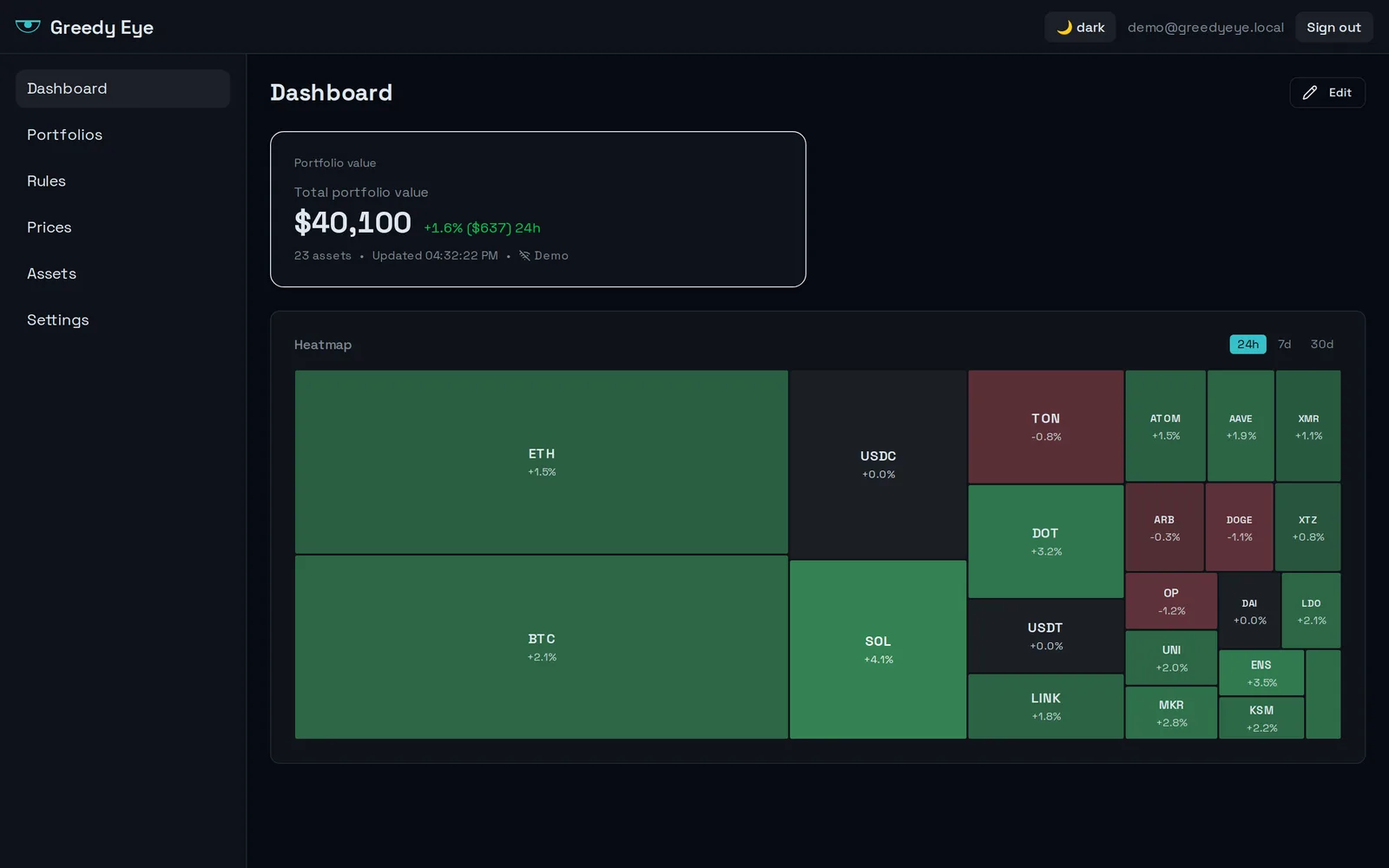
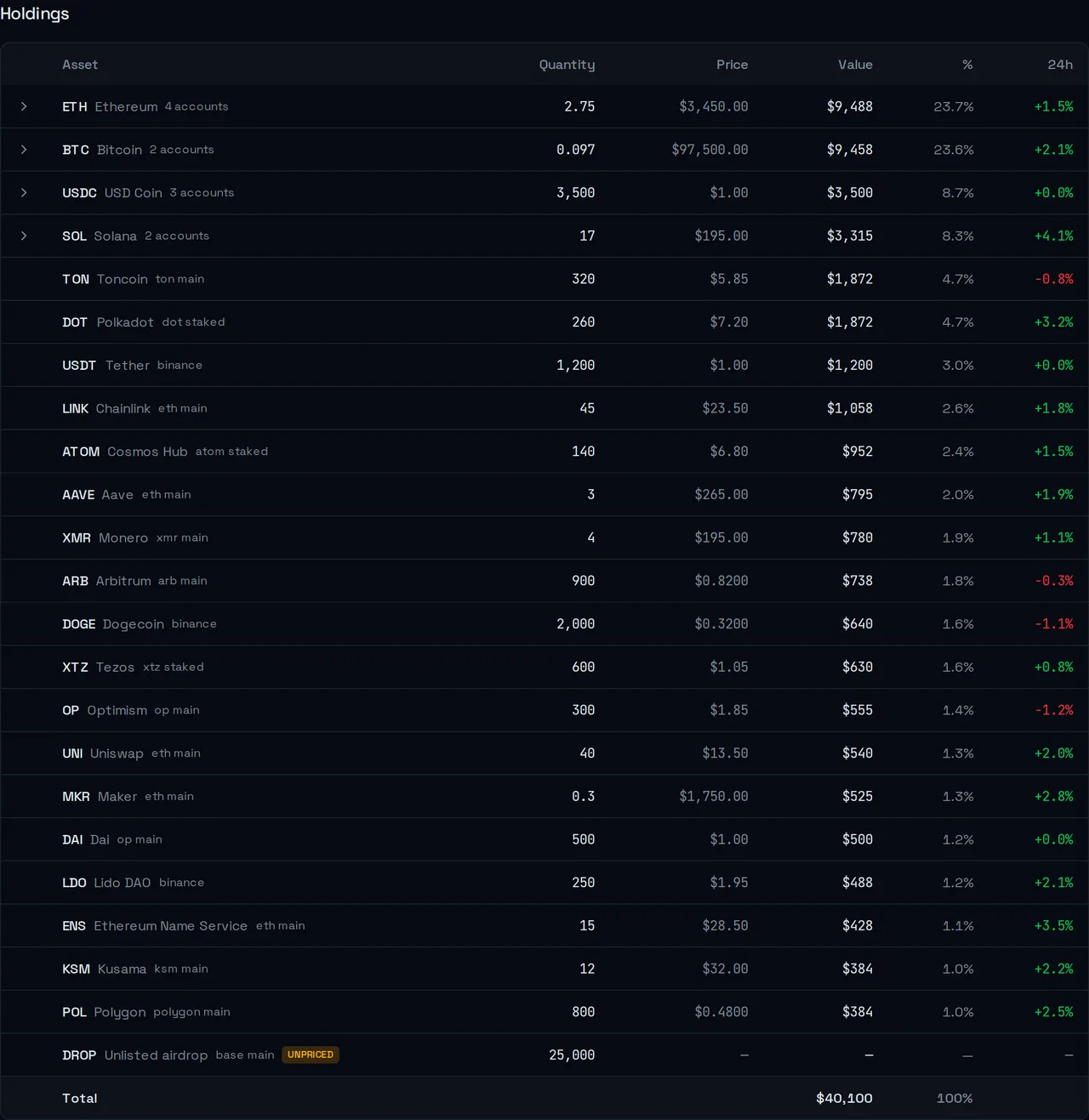
The total says what it is made of and what it left out. Unpriced positions show dashes, not zeros, and are listed with the reason.
Scam filter on identity
An asset is a symbol on a market of a type, plus its contract on a chain. A lookalike token is quarantined in the open, not subtracted quietly.
Prices on a budget
Scheduled price sweeps that divide each provider's plan across the period, so free tiers last. Several sources, freshest liquid quote wins.
Targets and drift
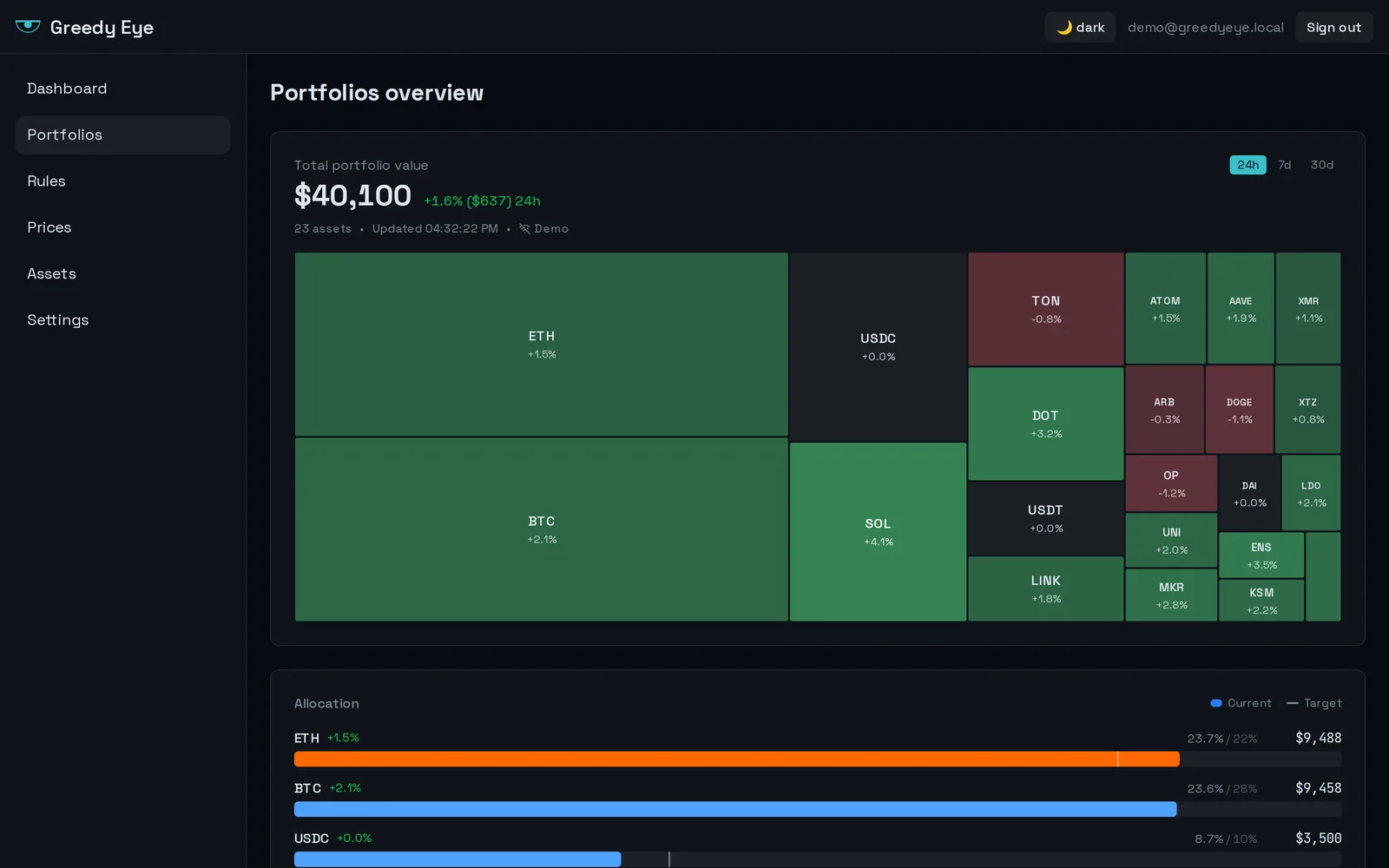
Set a target allocation and see what is over or under, by how much, in money. Rules can propose trades; paper trading runs today.
Yours to run
Your server, your database. Provider keys are encrypted at rest with your own master key. Talk to it from an AI assistant through the MCP server.
Run it
One compose file, three secrets
The whole stack runs from published images on a machine with Docker, amd64 or arm64.
- backend · Go
- frontend · Next.js
- auth · psina
- 2 × PostgreSQL
- reverse proxy
Download the compose file and the settings template:
curl -O https://raw.githubusercontent.com/foxcool/greedy-eye/main/deploy/selfhost/compose.yaml
curl -o .env https://raw.githubusercontent.com/foxcool/greedy-eye/main/deploy/selfhost/env.example
Fill in the three secrets
.envasks for:# a master key for provider credentials, back it up openssl rand -base64 32 # two database passwords openssl rand -hex 24Start it and open eye.localhost:8080:
docker compose up -d
It answers on 127.0.0.1 only. Sign-up cannot be closed yet, so reach it from your other devices through a VPN. In .env set EYE_BIND to the host's VPN address, EYE_HOST to the name you open it by (it needs a dot, e.g. a VPN hostname), and EYE_COOKIE_SECURE=false for plain http. Wallets on TON, Bitcoin, Cosmos and Tezos sync with no API keys; the provider list says what each of the others needs. Alpha software: expect rough edges, and file them as issues.
Under the hood
Production-shaped Go for financial data
Modular monolith
Five domain services in one binary, split into separate processes by configuration. A loopback stand proves every call still works over the wire.
Connect-RPC and PostgreSQL
Browser-friendly JSON and gRPC from one port; the protobuf files are the API. Raw SQL with pgx, versioned migrations, no ORM.
Decisions on record
Twelve architecture decision records: why a valuation reports what it could not price, why a quote with no market is not a value, why trades go through a wallet the user controls.